






Strength is definitely the most complex and hard to understand aspect of Tygras genetics. It is also the section that I am most likely to be slightly wrong about, since it is so complex - but I will share with you what information I have gathered through my studies of Tygras genetics, as well as offer you some speculation about their meaning!
The first thing to know about strength is.. what is it? When I refer to the "strength" of a gene, I am talking about the bulk of the "genetics box" that we have been talking about. For example...
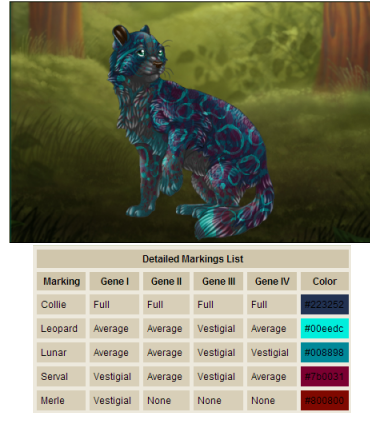
The "full, average, vestigial, and none" comments are what we refer to as gene strength. There are a few basic things about strength to learn first:
1. There are four genes, and each gene is essentially 1/4th of the total strength for that marking. There does not seem to be any difference between the four, they are all just equal parts to a whole.
2. There are five different possible strengths for each gene of each mraking: Full, Strong, Average, Vestigial, and None.
3. Each of the five different possible strengths indicates a percentage of the opacity of that marking - this is what "strength" really is. A lower strength marking willbe more see-through, while a higher strength marking more solid. Here is will list what I suspect to be the percentages per marking, but I could be wrong:
None - 0%
Vestigial - 33%
Average - 66%
Strong - 99%
Full - 100%
So taken all together, would add up the total of each of the four genes, and divide by four, to get the rough percentage of your marking.
Now on to the hard part...
The first thing to do is to realize that "Full" denotes that the marking is totally 100% strong, and that is is passed down directly from customs. This means none of the ancestors of a cub with a full marking have ever NOT had that marking. It is also only possible to have all four full - you cannot have one, two, or three genes be full with another gene being anything else. Another point to make is that once you have breed a line of tygras to a tygra that does not carry that marking, you will lose "full" and you will not get it back. The best you can get is all "strong" after that. We will talk about this more in depth later!
Since all tygras start with generation one customs, as there is no way to catch or otherwise acquire lower generation tygras, the first thing we will cover is what happens when you cross a tygra with full markings to a tygra without those markings. You remember Kafei and Willie and their cub:
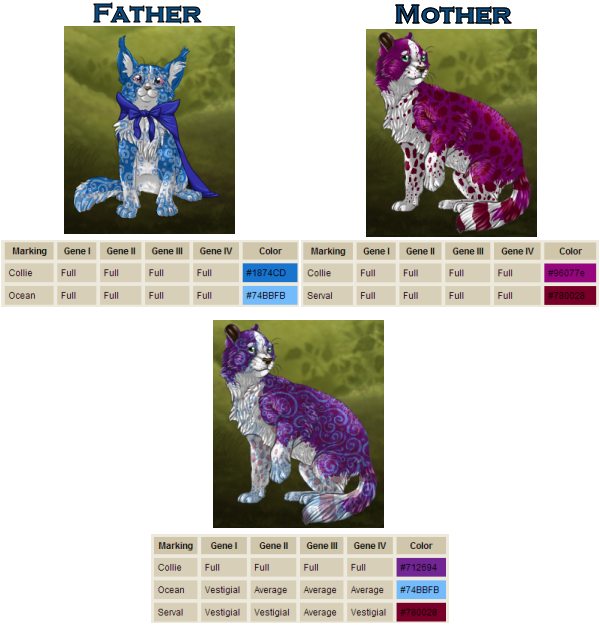
When you cross full to none, you will get a roughly 50/50 distribution of average and vestigial. Sometimes it will be 2:2, other times 1:3, but you will never have all four average or all four vestigial, and you will never have none or strong.
Now I will introduce the concept that I refer to as "breeding into" or "breeding out of" a marking. Breeding into a marking involved breeding lower markings (average, vestigial) to full, while breeding out of a marking means breeding to tygras with "none" either written out, or that lack the marking. Breeding in will result in raising the marking's strength, while breeding out will lower it. For example, lets look at this breeding between the father (left), the mother (right), and their resulting cub (bottom).
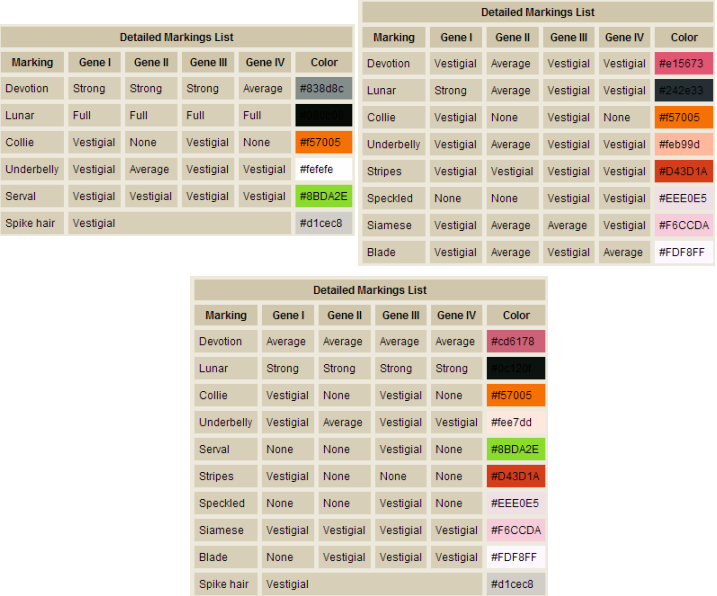
First look at the lunar marking. The father is full, while the mother has a combination of strong, average, and vestigial. This is breeding in, and results in all "strong" markings.
Now look at the stripes marking. The mother is all vestigial, while the dad is all none (he does not have stripes). The cub has three none and one vestigial - meaning her stripes are just barely there.
If you look at devotion, you can see we ended up somewhere in the middle - strongs and averages bred to averages and vestigials gave all average.
Determining what the strength of a particular gene on a given cub will be is difficult to do, as there are many possible outcomes and a lot of it seems to be random. For example, breeding a vestigial to a strong can result in vestigial, average, or strong. Breeding none to average can result in none, vestigial, or average. But remember, randomness is part of what makes tygras genetics so interesting!
The final two concepts on strength we will discuss are total breeding out, as well as the "Strong Cap."
It is possible to fully breed out markings in higher generations, to get a more "pure" tygra, if this is your objective. Say you have a lunar/devotion tygra that also happens to have some other markings you'd rather not keep. If you keep on breeding out, to tygras without those markings, you will eventually get all four "none" - and the markings will disappear off the list! For example...
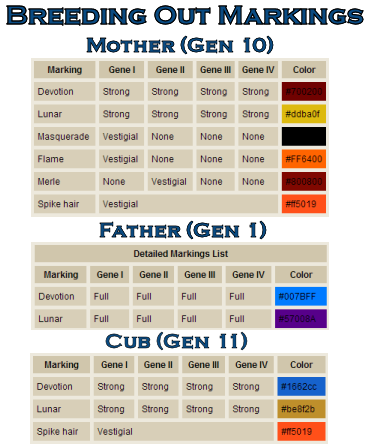
You can see how all that is left after continuing to breed out is the lunar and devotion! And of course the hair, but this seems to follow somewhat different rules.
The above example is also good for talking about the "strong cap" as I have come to think of it. It appears that no matter how many times you breed strong to full, it always remains strong. This makes sense, logically - no matter how many times you add 100 and then divide by two, you will never reach the full 100 again, even though you might get as has as 99.9999! As the game progresses, we may see a change in this, but for now I have not seen anybody return to "full" after that status has been lost once. Below is an example of a tygra with all "strong" markings (left) and one from the custom tester, will all "full" markings.
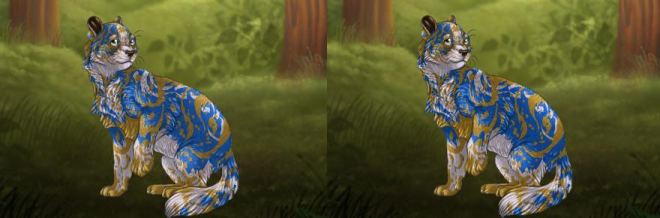
The two look almost identical - it simply looks like the colors on the left tygra may be a bit less bright.
Well hopefully now the complex system of opacity strength on tygras makes a little more sense! I will be especially interested in continuing to update this page as I learn more.
For now, why don't you continue on to...